


Planning a new commercial development involves much more than designing the building itself.
You also need to understand how your project will affect the surrounding roads, intersections, traffic flow, and overall transportation network. After all, a new office building, retail center, or apartment complex can bring hundreds or even thousands of additional vehicle trips everyday.
This is where a traffic impact assessment becomes necessary. A lot of cities and counties require this before approving a large commercial project.
For starters, traffic impact assessments help determine whether the existing road network can safely handle the additional traffic your development is expected to generate. If not, it also identifies the improvements needed to keep traffic moving safely and efficiently.
Simply put, it helps ensure that new developments don’t create unnecessary congestion, safety concerns, or operational issues for nearby roads and intersections.
In this blog, I will explain it all. You’ll know:
- What is traffic impact assessment
- Why traffic impact assessments are important
- How a traffic impact assessments are done
And much more.
So, let’s get into it.
Key takeaways
- A traffic impact assessment evaluates how a development will affect nearby roads and traffic operations.
- Terms like traffic impact assessment, traffic impact analysis, and traffic impact study mean the same thing and are often used interchangeably.
- Many municipalities require traffic impact assessments before approving commercial developments.
- Traffic engineers estimate future traffic generated by a project and evaluate whether nearby roads can accommodate it safely.
- Traffic impact assessments can recommend improvements such as new turn lanes, traffic signals, roadway widening, or access modifications.
What is traffic impact assessment?

For starters, a traffic impact assessment is a detailed traffic engineering study that checks how a proposed development will affect the surrounding transportation network.
Here, the transportation network includes everything that helps people and vehicles move safely from one place to another. This includes roads, intersections, driveways, traffic signals, sidewalks, bicycle facilities, and, in some cases, public transportation.
The main goal of a traffic impact assessment is to determine whether the extra traffic generated by a new development can be safely accommodated by the existing road infrastructure.
We help you identify structural concerns, navigate code compliance, and evaluate site risks with clarity.

Why is a traffic impact assessment important?
You see, every new development attracts traffic in one way or another. For instance:
- A shopping center brings customers throughout the day
- An office building generates traffic during morning and evening peak hours
- A warehouse sees regular truck movements
- An apartment complex adds daily commuter traffic
Now, these projects aren’t a major concern individually. But when hundreds of vehicle trips are added to nearby roads every day, they can quickly lead to congestion, longer travel times, safety concerns, and increased pressure on existing intersections.
This is exactly why traffic impact assessments play such an important role during the planning and approval process for commercial developments. It helps identify potential issues before the project is built, allowing developers, engineers, and local authorities to make informed decisions based on engineering data rather than assumptions.
For property developers in particular, this means better project planning, smoother reviews, and fewer surprises during the permitting process.
Overall, here’s why traffic impact analysis is important:
| Importance | Why it matters |
| Improves road safety | Identifies potential traffic conflicts before construction |
| Reduces congestion | Evaluates whether nearby roads can handle additional traffic |
| Supports permitting | Helps satisfy local development review requirements |
| Identifies needed improvements | Recommends roadway or intersection upgrades when necessary |
| Improves project planning | Helps developers address transportation issues early |
When is a traffic impact study required?
Generally speaking, a traffic impact study is required when a proposed development is expected to generate enough new traffic to affect nearby roads or intersections.
Now, the exact traffic impact study requirements vary from one city or county to another. And most city authorities have their own traffic impact study guidelines that specify when a traffic assessment is needed.
For instance, the city of Houston requires a traffic impact analysis for proposed developments that generate 100 or more new peak-hour trips.
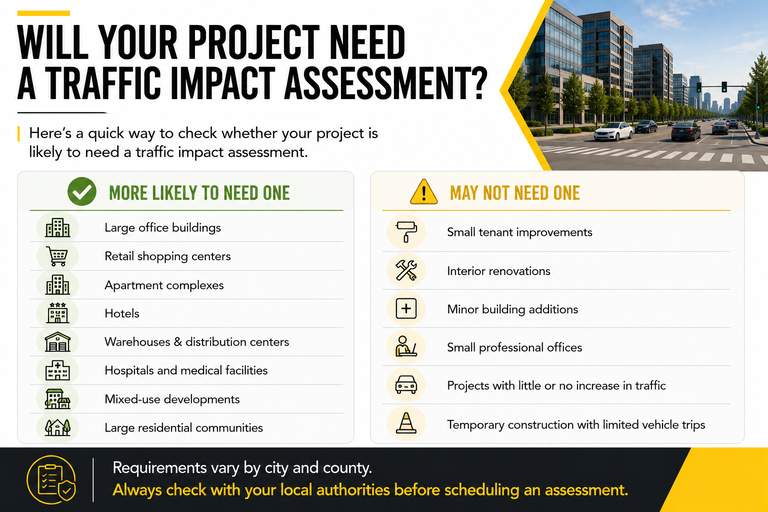
Here, traffic impact studies are commonly requested for projects such as:
- Office buildings
- Retail shopping centers
- Apartment complexes
- Hotels
- Restaurants
- Industrial facilities
- Warehouses
- Hospitals
- Schools and universities
- Mixed-use developments
- Large residential communities
In most cases, local agencies determine whether a traffic impact analysis is needed during the project’s initial development review. And if required, the analysis becomes part of the documents submitted for planning and permitting approval.
What information is included in a traffic impact study?
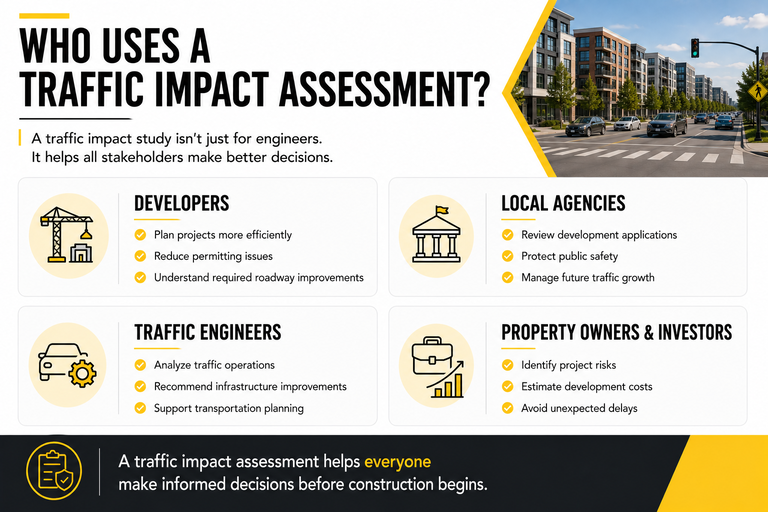
While every traffic impact study is unique, most include information such as:
- Existing traffic volumes
- Roadway and intersection conditions
- Vehicle turning movement counts
- Speed limits and roadway characteristics
- Crash history in the study area
- Site access locations
- Trip generation estimates
- Future traffic projections
- Capacity and intersection performance analysis
- Recommendations for transportation improvements
How is a traffic impact assessment done?

If you’ve worked on a commercial building before, you might already know what building inspectors look for in commercial properties.
But although traffic assessments are meant for commercial buildings, they don’t focus on the building structure or design. Instead, the focus is local traffic and how it might be impacted by the newly proposed building.
Although the exact assessment process varies depending on local guidelines, here’s how most traffic impact studies are done:
1. The study area is defined
The first step is determining which roads and intersections should be included in the study.
Here, traffic engineers work with the local agencies to establish the study area based on the size, location, and expected traffic.
For a small project, the study only included a few nearby intersections. But, for a larger commercial development, the study area might extend well beyond the project site to include major roads, highways, and intersections that could experience additional traffic.
2. Existing traffic data is collected
Once the study area has been established, engineers gather information about current traffic conditions.
This involves collecting traffic counts during peak travel periods, reviewing roadway layouts, documenting intersection controls, and evaluating existing traffic operations.
Depending on the project, engineers might also review crash history, pedestrian activity, bicycle facilities, transit access, and existing traffic signal timings.
3. Estimation of traffic generated by the development
Next, traffic engineers estimate how many vehicle trips the proposed development is expected to generate.
Here, engineers use established transportation engineering methods along with industry data to estimate the number of vehicles entering and leaving the site during different times of the day.
For instance, a warehouse, restaurant, office building, and apartment complex all generate traffic differently. While some experience heavy morning and evening commuter traffic, others see activity throughout the day.
That’s why, estimating future traffic accurately is one of the most important parts of the entire traffic impact study.
4. Future traffic conditions are analyzed
After estimating future traffic, engineers add those projected vehicle trips to the existing roadway network.
They then evaluate how nearby roads and intersections are expected to perform once the development is operational. This analysis looks at factors such as:
- Traffic delays
- Intersection capacity
- Vehicle queues
- Turning movements
- Overall traffic flow
The goal here is to determine whether the existing road network can safely accommodate the additional traffic or whether operational issues are likely to occur.
5. Transportation improvements are recommended
If the analysis identifies potential problems, traffic engineers recommend improvements to help maintain safe and efficient traffic operations.
Although the recommendations vary depending on the project and surrounding roadway conditions, some common recommendations include:
- Adding dedicated turn lanes
- Modifying driveway locations
- Installing or upgrading traffic signals
- Adjusting signal timing
- Widening roadways
- Improving pedestrian crossings
- Updating pavement markings and signage
6. The final traffic impact report is prepared
The final step is preparing the traffic impact study report. This report summarizes the entire analysis, including the traffic data collected, engineering methods used, study findings, and any recommended improvements.
The completed report is then submitted to the local authorities. For instance, in Houston, the report is submitted to the City of Houston Planning and Development Department or Houston Public Works as part of the development review and permitting process.
From there, the reviewing authority evaluates the study before making decisions related to project approval or any transportation improvements that might be needed.
We help you identify structural concerns, navigate code compliance, and evaluate site risks with clarity.
In short, here’s how a traffic impact study is done:
| Step | What happens |
| Define the study area | Determine which roads and intersections will be analyzed |
| Collect traffic data | Gather existing traffic counts and roadway information |
| Estimate future trips | Calculate traffic generated by the proposed development |
| Analyze traffic operations | Evaluate future roadway and intersection performance |
| Recommend improvements | Identify measures to improve safety and traffic flow |
| Prepare the report | Submit the completed traffic impact study for review |
Conclusion
I am sure that, by now, you have a clear understanding of what a traffic impact assessment is and why it plays such an important role in commercial development.
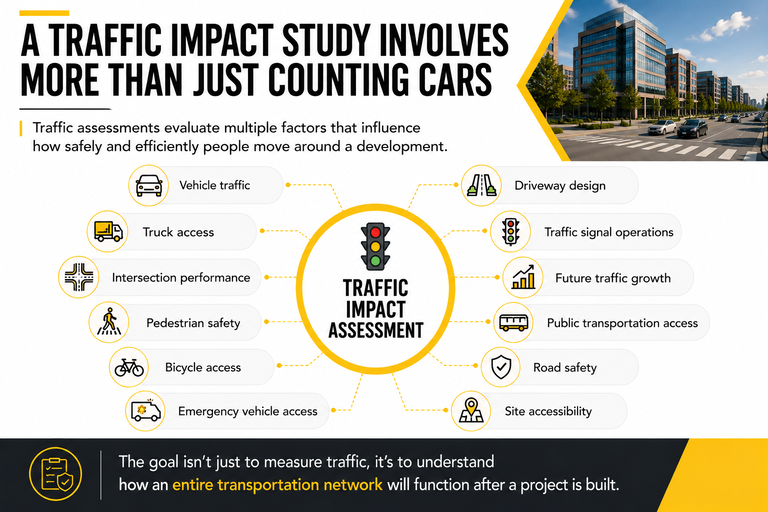
And as you can see, a traffic impact study is much more than simply measuring traffic volumes. It helps determine how a proposed development will affect nearby roads, intersections, and the overall transportation network before construction even begins.
This allows developers, property owners, engineers, and local agencies to identify potential traffic issues early and recommend practical solutions that improve safety, reduce congestion, and support smoother project approvals.
Got more questions or looking for traffic engineering services in Houston?
You can get in touch with us!
At Bullseye Engineering Inspection, our engineering and inspection services are backed by decades of local expertise and experience.
From traffic impact studies and civil engineering to commercial property inspections, we help developers, investors, business owners, and property managers make smarter decisions with confidence.
FAQs about traffic impact assessment
What is a traffic impact analysis?
A traffic impact analysis or assessment is an engineering study that evaluates how a proposed development will affect nearby roads, intersections, and the surrounding transportation network.
It estimates the amount of traffic a project is expected to generate and determines whether the existing road infrastructure can safely accommodate that additional traffic. If needed, the study also recommends roadway or traffic improvements to maintain safe and efficient traffic flow.
What is the difference between a traffic impact analysis and assessment?
There isn’t any significant difference.
Terms like traffic impact assessment, traffic impact analysis, and traffic impact study are often used interchangeably within the engineering industry.
While some city authorities might use one term over another, they generally refer to the same thing.
When is a traffic impact study required?
Traffic impact study requirements vary by city, county, or state.
Generally, a study is required when a proposed development is expected to generate enough vehicle traffic to noticeably affect nearby roads or intersections. Also, it can be conducted if the new traffic interferes with public right of way.
Larger commercial developments such as shopping centers, office buildings, apartment complexes, warehouses, hospitals, and mixed-use developments are among the projects most commonly required to prepare a traffic impact study.
How much does a traffic impact study cost?
The average traffic impact study cost in Houston is anywhere between $5,000 and $25,000. Here, smaller developments cost on the lower end while the assessment cost for big developments are higher. The exact cost will depend on the scope of your project.
How do engineers estimate traffic generated by a development?
Traffic engineers use established engineering methods along with recognized industry data to estimate the number of vehicle trips a development is expected to generate.
These estimates consider factors such as the type of development, building size, land use, and expected peak-hour traffic patterns before evaluating how those additional trips will affect nearby roads.
What information is included in a traffic impact assessment study?
A typical traffic impact study includes:
- Existing traffic volumes
- Roadway and intersection conditions
- Future traffic projections
- Site access analysis
- Capacity and traffic operations analysis
- Traffic safety considerations
- Recommended roadway improvements
The exact scope depends on the project and local agency requirements.
Who prepares a traffic impact study?
Traffic impact studies are typically prepared by qualified traffic or transportation engineers.
These professionals collect traffic data, analyze roadway performance, estimate future traffic conditions, and prepare the engineering report submitted to the local reviewing authority during the development approval process.
Can a traffic impact analysis delay a project?
Not necessarily.
In fact, completing a traffic impact analysis early in the planning process actually helps reduce delays by identifying transportation issues before construction begins.
Why are traffic impact assessments important for commercial developments?
Commercial developments often generate significantly more vehicle traffic than smaller residential projects.
A traffic impact assessment helps ensure nearby roads can safely handle that additional traffic while minimizing congestion, improving roadway safety, and supporting long-term transportation planning. It also provides local agencies with the information they need to make informed development decisions.