


As I explained in my previous blog, a traffic impact assessment is something you’ll most likely need when planning a large commercial development in Houston. This can be anything from an apartment complex to a retail center.
But how much does a traffic impact study cost?
This is one question a lot of Houston area property developers ask me.
To begin with, traffic impact study costs in Greater Houston range between $5,000 and $25,000+. Here, the exact cost will depend on the size of your development, local jurisdiction, and the complexity of the surrounding road network.
In fact, some traffic studies for some large developments even cost forward of $40,000.
In this blog, I have explained the cost of traffic impact study in detail, breaking it down for every building size. Also, I have detailed the biggest factors that affect the final price you pay.
So, let’s get into it.
Key takeaways
- Most traffic impact studies in Houston cost between $5,000 and $25,000+
- Smaller commercial developments often cost around $5,000-$10,000
- Larger developments can exceed $40,000 depending on the scope
- The number of intersections being analyzed is one of the biggest pricing factors
- Existing traffic counts, roadway complexity, and agency requirements all affect the final cost
- Projects involving TxDOT or multiple reviewing agencies generally cost more
- Additional traffic counts, simulation modeling, or revised site plans can increase pricing
- Every traffic impact study is different, so most engineering firms prepare custom proposals rather than offering flat-rate pricing
What is a traffic impact study?

A traffic impact study, also called a traffic impact analysis in Houston, evaluates how a proposed development will affect the surrounding roadway network.
These studies are required by both the City of Houston and the Texas Department of Transportation before approving new developments, rezoning requests, site plans, or building permits.
Here, the goal is to determine whether nearby roads and intersections can safely handle the additional traffic your project is expected to generate.
A professional traffic impact study includes the following:
- Existing traffic volume counts
- Trip generation analysis
- Trip distribution and assignment
- Intersection capacity analysis
- Level of Service (LOS) evaluation
- Queue length analysis
- Safety review
- Access and driveway evaluation
- Recommendations for roadway improvements
- A detailed engineering report
How much does a traffic impact study cost in Houston?

In Houston, most traffic impact studies cost anywhere between $5,000 and $25,000 or more.
However, the average traffic impact study cost for many standard commercial developments is between $8,000 and $15,000.
The final cost depends on the size of the proposed development, number of intersections that need to be analyzed, existing traffic conditions, jurisdiction requirements, and amount of engineering analysis needed.
For instance, a traffic study for a small retail building will be very less than one for a new apartment complex, distribution center, or mixed-use development.
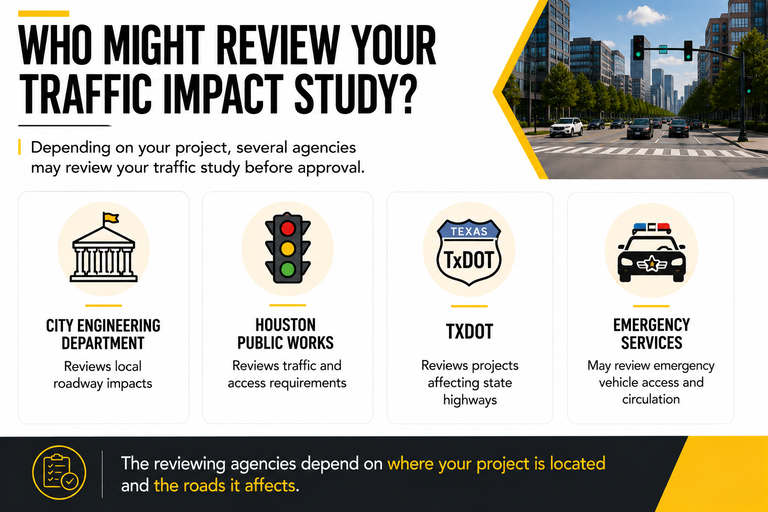
Similarly, projects that require coordination with agencies like Houston Public Works or TxDOT involve additional analysis and documentation, which can increase the overall cost.
We help you identify structural concerns, navigate code compliance, and evaluate site risks with clarity.

How much does a traffic impact study cost by project size?
The most common way Houston traffic engineers estimate pricing is based on the overall size and complexity of the proposed development.
That’s because larger developments generate more vehicle trips, affect more nearby intersections, and require more detailed traffic analysis.
Here, engineers spend more time collecting traffic data, analyzing roadway performance, and preparing documentation for the reviewing agency.
Here are average traffic impact study cost ranges for Houston based on project size:
1. Small commercial developments: $5,000-$10,000
Smaller projects are usually the least expensive to study. This includes small retail buildings, standalone restaurants, office buildings, convenience stores, daycare centers, or similar developments that generate relatively low traffic volumes.
Since these projects affect only a few nearby intersections, the study is less time-consuming and requires fewer traffic analyses.
2. Medium-sized developments: $10,000-$20,000
As developments get larger, the traffic study becomes more involved. This includes shopping centers, medical offices, self-storage facilities, schools, churches, or mid-sized apartment communities.
Here, engineers need to evaluate multiple intersections, analyze peak-hour traffic conditions, estimate future traffic volumes, and determine whether roadway improvements are necessary. As a result, the traffic impact study cost increases.
3. Large commercial developments: $20,000-$40,000+
Large developments require significantly more engineering work. This includes industrial parks, distribution centers, mixed-use developments, business parks, large apartment complexes, hospitals, or major retail centers.
These studies involve extensive traffic modeling, numerous intersections, multiple access points, and coordination with local agencies.
Now, because of the additional scope, traffic study cost for these projects can sometimes exceed $40,000.
4. Complex developments requiring extensive analysis: $30,000-$50,000+
Some developments require much more than a standard traffic impact study.
For instance, projects located near congested intersections, state highways, major employment centers, or rapidly growing areas require additional traffic modeling and more detailed engineering analysis.
Similarly, developments that require coordination with TxDOT or multiple jurisdictions involve additional review comments and revisions.
Since these projects demand considerably more engineering time, the overall cost can increase substantially.
In short, here’s how much does a traffic study cost based on project size:
| Project Size | Typical Cost Range |
| Small commercial developments | $5,000-$10,000 |
| Medium-sized developments | $10,000-$20,000 |
| Large commercial developments | $20,000-$40,000+ |
| Complex projects | $30,000-$50,000+ |
Why does traffic impact study cost vary so much?
One thing you might have noticed is how different traffic impact study costs can be.
For instance, one engineering firm might quote $7,000, while another estimates $18,000 for what appears to be a similar project.
Every traffic impact study is different. Some developments only require a basic analysis of a few nearby intersections, while others involve extensive traffic modeling, multiple roadway segments, agency coordination, and several rounds of revisions.
And this is what causes the cost of traffic studies to vary so much.
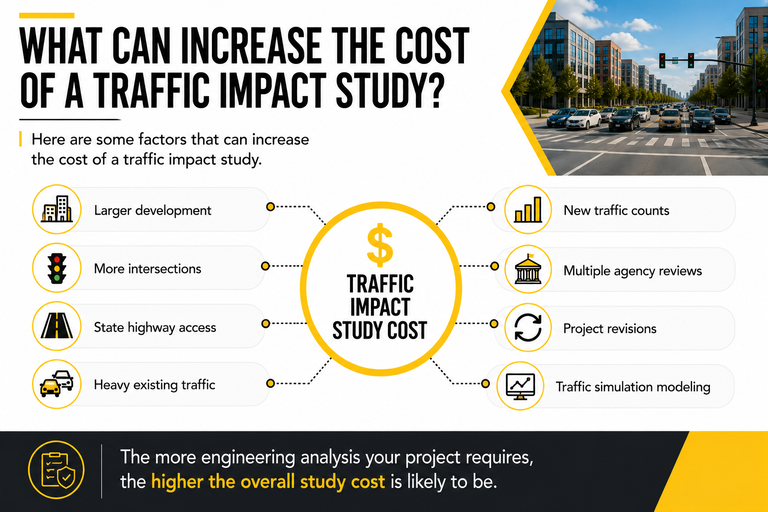
Overall, here are the biggest factors that affect traffic impact study cost.
1. Project size
This is the biggest pricing factor.
A small office building that generates only a few hundred vehicle trips per day is much easier to analyze than a large mixed-use development that attracts thousands of trips.
Larger developments, on the other hand, require more engineering work as they affect more intersections, generate more traffic, and require a much more detailed analysis.
2. Number of intersections being studied
Every additional intersection means more traffic counts, more data analysis, more capacity calculations, and more documentation.
For a simple project, engineers might only evaluate two or three nearby intersections. But larger developments require analysis of ten or more intersections depending on local agency requirements.
So, the more intersections involved, the higher the overall cost.
3. Existing traffic conditions
A development located on a quiet suburban roadway is much easier to study than one located near a busy freeway interchange or heavily congested urban corridor.
At the same time, areas with existing traffic congestion require more detailed operational analysis, which increases both the engineering effort and the overall project cost.
4. Local agency requirements
Not every municipality has the same traffic study requirements.
Even in the Houston area, requirements can vary depending on the city, county, or reviewing agency involved.
For instance, some projects require coordination with the Texas Department of Transportation if access to a state highway is involved.
In these cases, additional review requires more documentation, more engineering analysis, and sometimes multiple revisions before final approval.
5. Existing traffic data
Sometimes, recent traffic count data is already available. If it is, engineers are able to use that information as part of the study.
But in many cases, new traffic counts need to be collected. This involves sending field crews to record traffic volumes during peak hours, which adds both time and cost to the project.
6. Scope changes during the project
The scope of the project sometimes changes after the study has already started.
For instance, the site layout might change, additional buildings can be added, or the reviewing agency can request that more intersections be analyzed.
When that happens, engineers need to update their analysis and revise the report. These additional services can increase the final traffic impact study cost.
What’s included in a traffic impact study?
A professional traffic impact study is designed to evaluate how your proposed development will affect the surrounding transportation network and whether any roadway improvements might be needed.
Now, the exact scope of study depends on the project and the reviewing agency. But most traffic impact studies include:
1. Existing traffic data collection
Engineers begin by collecting information about current traffic conditions around the proposed development. This can include traffic counts at nearby intersections, roadway volumes, turning movements, and peak-hour traffic patterns.
The goal is to establish a clear picture of how traffic currently operates before analyzing the impact of the new development.
2. Trip generation analysis
Next is trip generation analysis where engineers estimate how many vehicle trips the proposed development is expected to generate. This is based on nationally recognized transportation data and the type of development being proposed.
For instance, a restaurant generates traffic very differently than an office building or warehouse.
3. Traffic distribution and assignment
After estimating the number of trips, engineers determine where those vehicles are likely to come from and where they’ll go.
This helps identify which nearby roads and intersections will experience the greatest increase in traffic.
We help you identify structural concerns, navigate code compliance, and evaluate site risks with clarity.
4. Intersection analysis
One of the most important parts of a traffic impact study is evaluating nearby intersections. Here, engineers analyze how intersections are expected to perform after the proposed development is built.
5. Access evaluation
Engineers also review the proposed driveways and site access points. The goal is to ensure vehicles can safely enter and exit the property without creating unnecessary congestion or safety concerns on nearby roads.
6. Recommendations and final report
Once the analysis is complete, the engineering team prepares a detailed traffic impact study report. This includes:
- Existing traffic conditions
- Traffic forecasts
- Capacity analysis
- Identified impacts
- Recommended roadway improvements (if needed)
- Supporting maps, figures, and engineering calculations
This report is then submitted to the reviewing agency as part of the development approval process.
You might also want to read – Civil Engineers Cost: What Can You Expect To Pay In Texas?
Bonus: Here are some red flags to watch for while hiring a traffic engineer in Houston
| Red Flag | What It Means | Why It’s a Problem |
| Extremely low pricing | Quote is far below other firms | Important analysis might be missing |
| No experience with Houston projects | Limited local knowledge | May not understand local review requirements |
| No discussion about project scope | One-size-fits-all proposal | The final cost might increase later |
| Unrealistically fast turnaround | Promises to finish unusually quickly | Quality and accuracy might suffer |
| Vague proposal | Unclear deliverables | You may not know what’s actually included |
| No revisions included | Every revision costs extra | Agency comments can significantly increase your costs |
Conclusion
I am sure you now have a much better idea of how much a traffic impact study costs in Houston.
And as you can see, pricing can vary depending on the size of the development, the number of intersections being analyzed, local agency requirements, and the complexity of the project.
Most traffic impact studies in Houston fall somewhere between $8,000 and $15,000 for many standard commercial developments.
Here, smaller projects may cost closer to $5,000, while larger developments requiring extensive traffic analysis and agency coordination can easily exceed $40,000.
The best way to get an accurate estimate is to have an experienced traffic engineering firm review your project and prepare a proposal based on its specific requirements.
Got more questions or need a traffic impact study in Houston?
You can get in touch with us.
At Bullseye Engineering Inspection, we provide professional traffic engineering services, traffic impact studies, and engineering evaluations for commercial developments throughout Houston and across Texas.
Whether you’re planning a retail center, apartment community, office development, or industrial facility, our team can help you understand your project’s traffic requirements and guide you through the approval process.
FAQs about traffic impact study cost
How much does a traffic impact study cost on average?
The average traffic impact study cost for many commercial developments in Houston typically falls between $8,000 and $15,000.
However, smaller projects may cost around $5,000-$10,000, while larger developments requiring more extensive traffic analysis can exceed $40,000 depending on the project scope.
What affects traffic impact study cost the most?
The biggest factors that affect traffic impact study cost include:
- Project size
- Number of intersections being analyzed
- Existing traffic conditions
- Local agency requirements
- Traffic data collection needs
- Overall engineering scope
How long does a traffic impact study take?
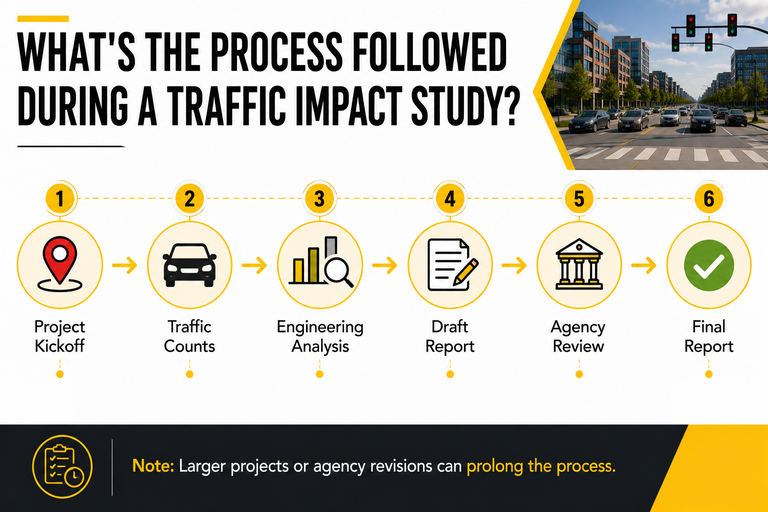
Most traffic impact studies take anywhere from three to eight weeks to complete.
However, larger or more complex projects can take longer if additional traffic counts, agency reviews, or revisions are required.
Who requires a traffic impact study?
Many cities, counties, and transportation agencies require traffic impact studies before approving certain developments.
These studies are commonly requested for commercial buildings, apartment communities, industrial facilities, mixed-use developments, schools, and other projects expected to generate significant traffic.
What’s included in a traffic impact study?
A traffic impact study typically includes:
- Existing traffic counts
- Trip generation analysis
- Traffic distribution
- Intersection capacity analysis
- Access evaluation
- Recommendations for roadway improvements
- A detailed engineering report
Is a traffic impact study the same as a traffic study?
In many cases, yes.
The terms traffic impact study, traffic impact analysis (TIA), and traffic study are often used interchangeably.
Can the cost of a traffic impact study increase after work begins?
Yes, it can.
If the project changes significantly, additional intersections need to be analyzed, or the reviewing agency requests more information, the engineering scope may expand.
When that happens, the total project cost can increase accordingly.