

Whether you’re purchasing a commercial property, managing a facility, or scheduling a routine property assessment, hiring the right commercial inspector is among the most important decisions you’re going to make.
After all, the quality of the inspection, and the potential problems it is able to detect, largely depends on the person performing it.
You see, commercial buildings involve complex structural systems, HVAC equipment, electrical infrastructure, plumbing networks, fire safety systems, and more.
These are components that require specialized knowledge to assess properly. And if an inspector lacks the necessary qualifications, important issues can easily go unnoticed.
This is exactly why understanding building inspector qualifications is so important before you hire anyone.
Now, the good part is that you don’t need to be an expert to check an inspector’s credentials. Even a basic understanding of what inspector qualifications can help you make an informed decision.
In this blog, I’ll explain it all. You’ll know:
- What qualifications building inspectors should have
- Why inspector qualifications matter so much
- The most important credentials to look for
- How experience impacts the quality of commercial inspection in Houston
- Why reporting skills are just as important as technical knowledge
- Questions you should ask before hiring a commercial inspector
So, let’s get into it.
Key takeaways
- Building inspector qualifications go beyond simply having a license
- Commercial inspection experience is one of the most important qualifications to look for
- Professional certifications can demonstrate additional training and expertise
- A qualified inspector should have strong knowledge of building systems and construction practices
- Attention to detail and reporting skills are critical for identifying and communicating issues
- Hiring an underqualified inspector can lead to missed defects and costly surprises later
What qualifications do building inspectors need?
For starters, there isn’t one single qualification that automatically makes someone a great commercial building inspector.
Commercial inspections require a combination of education, technical knowledge, field experience, certifications, and professional judgment. That’s because commercial properties are far more complex than residential buildings.
For instance, even if the inspector follows a basic commercial building inspection checklist, they might be assessing:
- Large roofing systems
- Complex HVAC equipment
- Extensive electrical infrastructure
- Fire protection systems
- Structural components
- Commercial plumbing systems
- Site drainage systems
- Accessibility features
And each of these areas requires a certain level of expertise to properly assess.
This is exactly why the best commercial inspectors typically bring together multiple qualifications rather than relying on a single credential.
For instance, one inspector might hold professional certifications but have limited commercial experience. On the other hand, another inspector might have decades of field experience but lack ongoing professional training.
Now, you want someone who brings both certifications and experience.
We help you identify structural concerns, navigate code compliance, and evaluate site risks with clarity.

Here are all the building inspector qualifications you should look for before hiring someone
1. Proper licensing
One of the first building inspector qualifications you should verify is whether the inspector holds any required licenses in their state or jurisdiction.
Now, licensing requirements can vary depending on where the inspection takes place. For instance, in Texas, only a licensed professional real estate inspector can perform commercial property inspections.
This is why it’s important you understand your local requirements and verify that the inspector meets them.
After all, licensing shows that an inspector has met certain education, training, testing, or professional standards established by regulatory authorities. Also, it shows that they are operating legally within their jurisdiction.
Now, a license alone does not guarantee that someone is an excellent commercial inspector. However, it is still seen as an important baseline qualification.
2. Relevant certifications
Another important qualification for a building inspector is professional certification.
You see, commercial buildings contain many different systems and components. And because inspection standards continue to evolve, ongoing education plays a major role in maintaining professional competence.
This is where certifications become valuable.
Professional certifications indicate that an inspector has completed additional training, passed industry examinations, and committed to continuing education.
Some common certifications and professional credentials commercial inspectors hold include:
- ICC Commercial Building Inspector B2 Certification
- CCPIA Certified Commercial Property Inspector
- Property condition assessment training
- Specialized roofing certifications
- Mechanical system certifications
- Engineering licenses (where applicable)
- Industry association memberships like InterNACHI membership
Now, certifications should never be viewed in isolation.
For instance, if someone holds several certifications but has very little real-world commercial inspection experience, they might not be right for you. This is why you should evaluate certifications alongside experience and technical expertise.
3. Extensive commercial inspection experience
If there’s one qualification that deserves special attention, it’s commercial inspection experience.
After all, commercial properties are very different from residential homes. They involve:
- Large-scale HVACs
- Complex electrical distribution systems
- Commercial roofing assemblies
- Industrial equipment
- Fire suppression systems
- Multiple occupancy areas
- Specialized mechanical systems
As a result, commercial inspections require a very different level of knowledge and field experience.
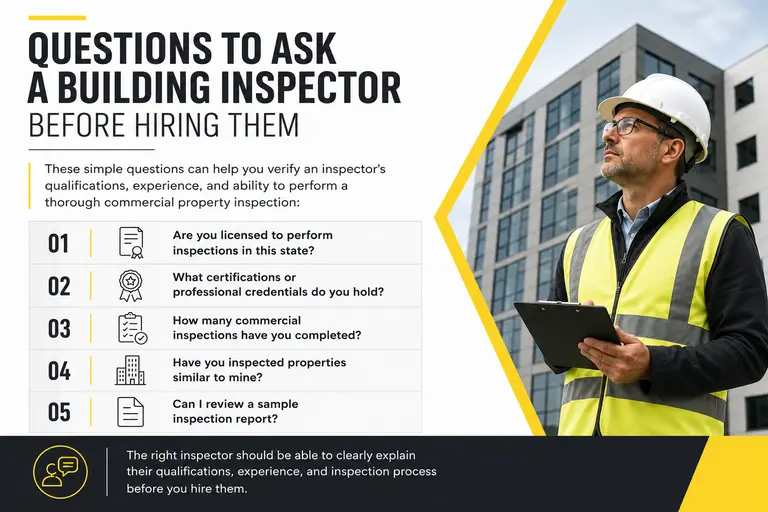
This is exactly why you should ask inspectors about their commercial background. For instance, you can ask the following questions:
- How long have you been performing commercial inspections?
- What types of commercial properties do you inspect?
- Have you inspected buildings similar to mine?
- How many commercial inspections do you complete annually?
These questions can provide you valuable insight into their experience level.
4. Strong knowledge of major building systems
A commercial building is essentially a collection of interconnected systems working together. And if one system fails, it can often affect several others.
This is exactly why inspectors need a strong understanding of how major building systems function and interact. After all, they’ve to assess the visible condition, performance, and overall functionality of building systems to identify signs of defects, deficiencies, or potential concerns.
For instance, an inspector evaluating a rooftop HVAC unit should understand:
- Equipment operation
- Ventilation requirements
- Common failure points
- Maintenance concerns
- Service life expectations
Similarly, when assessing electrical systems, they should be able to recognize:
- Overloaded panels
- Safety hazards
- Improper installations
- Signs of overheating
- Visible code-related concerns
Without this technical knowledge, important issues can easily go undetected.
5. Understanding of building codes and industry standards
Another important building inspector qualification is a strong understanding of building codes, safety requirements, and industry standards.
Now, this is where many property owners get confused.
A commercial property inspection is not always the same as a formal code compliance inspection. In most cases, inspectors are evaluating the property’s overall condition rather than conducting a comprehensive code enforcement review.
However, inspectors should still have a solid understanding of applicable building standards and safety requirements.
Why?
That’s because this knowledge helps them identify conditions that might present safety concerns, operational risks, or potential compliance issues.
For instance, inspectors should be able to identify:
- Blocked emergency exits
- Missing safety features
- Accessibility concerns
- Guardrail deficiencies
- Fire safety issues
- Unsafe electrical conditions
- Life safety hazards
6. Attention to detail
You’d be surprised how often major building problems start as small issues that initially seem insignificant.
It could be a minor roof leak, a small crack in a wall, a bit of corrosion on mechanical equipment, or a drainage issue near the foundation.
Individually, these might not appear serious at first glance. But over time, they can lead to expensive repairs, operational disruptions, water intrusion, structural damage, or equipment failure.
This is exactly why attention to detail is one of the most important qualifications for a building inspector.
After all, inspections are largely about observation. And what building inspectors look for are warning signs that could indicate deeper problems within the property.
7. Ability to produce clear and detailed reports
Even the most knowledgeable inspector has limited value if they cannot clearly communicate their findings. This is why reporting skills are among the most important building inspector qualifications.
You see, the inspection report is ultimately what clients rely on when making decisions.
Whether you’re purchasing a property, planning repairs, negotiating a transaction, or budgeting for maintenance, the report becomes your primary source of information.
This is exactly why a high-quality inspection report should be:
- Clear
- Organized
- Easy to understand
- Detailed
- Well-documented
It should also include:
- Photographs
- Deficiency descriptions
- Maintenance observations
- Safety concerns
- Recommendations for further evaluation
- Repair priorities
Now, a good report shouldn’t overwhelm clients with unnecessary technical jargon. Instead, it should explain findings clearly, in a way that allows property owners, investors, facility managers, and buyers to understand what was observed and why it matters.
Pro tip: Before hiring an inspector, do ask for a commercial inspection report sample.
This gives you an opportunity to evaluate:
- Report quality
- Level of detail
- Organization
- Clarity
- Documentation style
8. Integrity and professionalism
Last but certainly not least, integrity and professionalism are qualifications that should never be overlooked.
After all, commercial inspections play an important role in real estate transactions, investment decisions, maintenance planning, and risk management. And clients depend on inspectors to provide objective and unbiased assessments.
A professional inspector should report findings honestly, regardless of whether those findings are favorable or unfavorable. Their responsibility is to accurately communicate the property’s condition, not to influence a transaction.
And to that end, they should answer questions openly, explain their findings clearly, and maintain a professional approach throughout the inspection process.
In short, here are all the building inspector qualifications you should look for:
| Qualification | Why It Matters |
| Proper Licensing | Verifies compliance with applicable requirements |
| Professional Certifications | Demonstrates additional training and expertise |
| Commercial Inspection Experience | Helps identify property-specific risks and deficiencies |
| Building Systems Knowledge | Supports accurate evaluation of major systems |
| Code & Standards Knowledge | Helps identify safety and operational concerns |
| Attention To Detail | Reduces the likelihood of missed defects |
| Strong Reporting Skills | Provides clear and useful inspection findings |
| Integrity & Professionalism | Ensures objective and trustworthy assessments |
We help you identify structural concerns, navigate code compliance, and evaluate site risks with clarity.
Conclusion
I am sure that by now, you have a much clearer understanding of the building inspector qualifications that truly matter when hiring a commercial inspector.
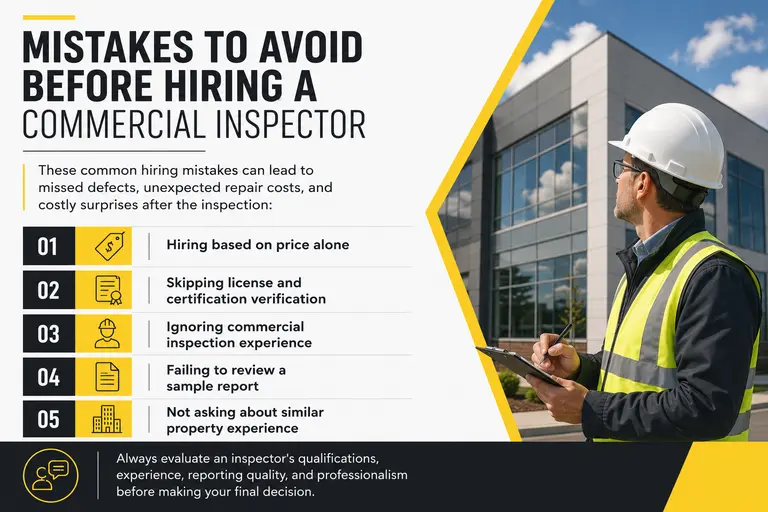
As you can see, choosing an inspector isn’t simply about finding the lowest price or the fastest availability.
Here, the goal is to find someone with the right combination of licensing, certifications, commercial experience, technical knowledge, attention to detail, reporting skills, and professional integrity.
After all, a commercial inspection is often one of the most important steps in evaluating a property’s condition. And the quality of that inspection depends heavily on the person performing it.
Got questions about commercial inspections or looking to hire a civil engineering firm in Houston?
You can get in touch with us.
At Bullseye Engineering Inspection, our engineering and inspection services are backed by decades of experience and local expertise.
We help commercial property owners, investors, developers, and buyers gain a clear understanding of a property’s conditions so they can plan, build, invest, and make informed decisions with confidence.
FAQs about building inspector qualifications
What qualifications do building inspectors need?
Commercial building inspectors typically need a combination of licensing, certifications, technical knowledge, field experience, and professional training.
The most important qualifications include:
- Commercial inspection experience
- Relevant certifications
- Knowledge of building systems
- Strong reporting skills
- Attention to detail
- Professional integrity
Do commercial building inspectors need a license?
Licensing requirements vary by state and jurisdiction. For instance, commercial building inspectors in Texas need a professional real estate inspector license.
It’s always a good idea to verify licensing requirements in your area before hiring an inspector.
What certifications should a commercial building inspector have?
The certifications an inspector holds can vary depending on their background and area of expertise.
Common credentials might include:
- ICC certifications
- Commercial inspection certifications
- Property condition assessment training
- Engineering licenses
- Industry association memberships
However, certifications should always be evaluated alongside experience and practical knowledge.
Can a residential inspector perform a commercial inspection?
Some residential inspectors can perform commercial inspections, but commercial properties are often much more complex than residential buildings.
This is why it’s generally best to hire someone with specific commercial inspection experience, especially for larger or more complicated properties.
How can I verify an inspector’s qualifications?
You can verify an inspector’s qualifications by asking about:
- Licensing
- Certifications
- Commercial experience
- Professional memberships
- Sample inspection reports
- References
These details can help you evaluate their expertise and professionalism before hiring them.
Why is experience important in commercial inspections?
Experience helps inspectors recognize issues that may not be obvious to less experienced professionals.
An inspector who has evaluated a wide range of commercial properties is often better equipped to identify deficiencies, maintenance concerns, and potential risks that could affect the property’s long-term performance.