

You might have seen a large open area that looks like a pond or a grassy field while driving through a new residential subdivision, commercial development, or large parking lot.
But why is it there?
Well, that’s a stormwater detention basin. It is an important part of civil engineering and drainage design because construction changes the way rainwater moves through a property.
You see, in an open field, rainfall soaks into the soil or moves slowly across vegetation and natural ground surfaces. But once you add buildings, concrete, roads, parking lots, and other impervious surfaces, rainwater runs off much faster.
And when this extra runoff reaches drainage systems all at once, it increases the risk of flooding, erosion, and overloaded drainage systems.
This is where storm water detention helps. A part of SWPPP requirements in Texas, it temporarily stores excess stormwater and releases it at a controlled rate so that the downstream drainage system doesn’t get overloaded.
In this blog, I have explained it all, including:
- What is storm water detention?
- How does it work?
- Why is storm water detention so important in Texas?
- And much more.
So, let’s get into it.
Key takeaways
- Stormwater detention temporarily stores excess rainwater runoff and releases it at a controlled rate.
- It helps reduce peak runoff and prevents downstream drainage systems from becoming overloaded.
- Storm water detention is important in Texas because construction increases runoff and can contribute to flooding.
- Proper detention design requires engineering calculations for runoff, storage volume, discharge rates, and outlet structures.
What is stormwater detention?
Storm water detention is the temporary storage of rainwater runoff before it is released at a controlled rate.
You see, when rain falls on an undeveloped property, some of that water goes into the ground. Also, vegetation, soil, and natural terrain slow down the movement of water.
But when the same property has buildings, parking lots, driveways, and concrete pavements, a large part of that rainwater becomes surface runoff. Also the rainwater reaches drainage systems much faster.
This put extra pressure on storm sewers, drainage channels, culverts, and nearby waterways. Worse, if the drainage system downstream cannot handle the increased flow, it can result in flooding and erosion.
A stormwater detention system helps manage this problem by temporarily holding the excess runoff and releasing it more slowly.
We help you identify structural concerns, navigate code compliance, and evaluate site risks with clarity.

How does a stormwater detention system work?
The basic idea behind storm water detention is simple.
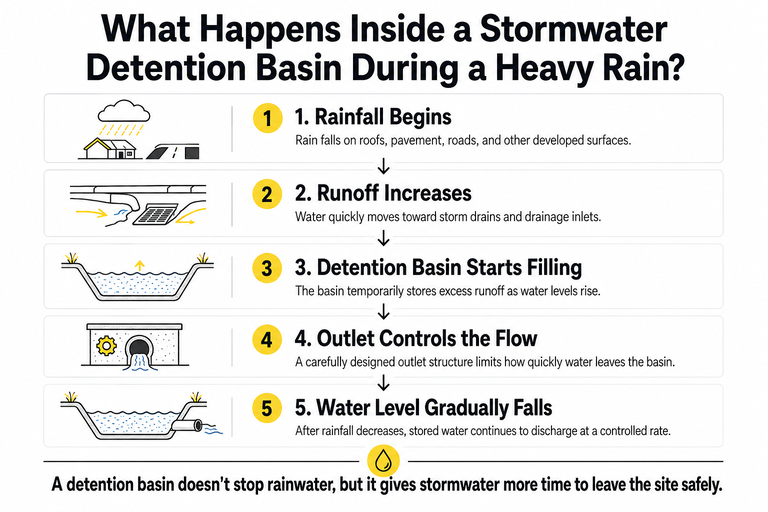
During a storm, runoff from roofs, parking lots, roads, and other developed areas is collected and directed toward the storm water detention facility.
Here, the detention facility can be a surface basin, a stormwater detention pond, an underground vault, large pipes, or another engineered storage system.
Now, as rainwater enters the facility, the excess water temporarily builds up inside the available storage volume. Then, an outlet structure controls how quickly that water is released.
Harris County Flood Control District describes this as ‘a lake with no water.’ The idea is that the system receives a large amount of runoff but allows it to leave at a much slower, controlled rate.
Once the storm passes and rainwater inflow decreases, the stored water continues to drain until the detention facility returns to its normal condition.
What is a stormwater detention basin?
A stormwater detention basin is an engineered area designed to provide temporary storage for excess stormwater runoff.
These basins are commonly in residential and commercial properties, and other developed areas. They look like large grassy fields or ponds and they’re designed to remain dry between significant rainfall events.
A detention basin includes:
- An inlet: Brings stormwater into the basin.
- A storage area: Temporarily holds excess runoff.
- An outlet structure: Controls the rate at which water leaves the basin.
- An emergency overflow: Provides a safe discharge path during extreme rainfall events.
In Houston, detention basins are an important part of stormwater management because they provide temporary storage and help manage the increased runoff.
Stormwater detention vs retention: What’s the difference?
A lot of people use detention and retention interchangeably, but they are not the same thing.
The biggest difference is this:
- Storm water detention temporarily holds water and releases it at a controlled rate.
- A retention pond, on the other hand, is designed to store water permanently.
Overall, here are all the differences between storm water detention vs retention:
| Storm water detention | Storm water retention |
| Temporarily stores water | Permanently stores a pool of water |
| May be dry between storms | Normally has standing water |
| Primarily controls peak runoff | Can provide water quality and other functions |
| Uses controlled outlets | Water may remain stored or be managed differently |
Civil Engineer’s Tip: In Texas, the terminology can vary between jurisdictions and projects. I suggest you look at the applicable local drainage requirements rather than assuming a project needs one type of pond simply because of the terminology.
Why is stormwater detention so important in Texas?

Texas has seen tremendous growth over the past few years. New homes, commercial buildings, roads, parking lots, warehouses, and other developments continue to be built on undeveloped land.
And although this itself isn’t the problem, it changes how rainfall moves across the property. Since there are more impervious surfaces, it means more runoff and faster runoff.
As per TxDOT, increased development increases rainwater runoff rates and volumes. This requires larger drainage infrastructure and potentially also increases damage to downstream properties.
That’s one reason detention has become an important part of drainage design across Texas.
This is particularly important in areas like Houston where heavy rainfall and flooding are ongoing concerns.
A properly designed detention facility can help reduce the peak rate of runoff leaving a developed property and reduce the impact on downstream drainage systems.
Civil Engineer’s Tip: I always tell property owners and developers that detention should not be treated as an afterthought. If you wait until the site plan is already finalized to figure out where the detention facility will go, you’ll find that you don’t have enough usable space. A good civil engineer can help you plan both drainage and detention early, avoiding expensive redesigns later.
We help you identify structural concerns, navigate code compliance, and evaluate site risks with clarity.
What goes into storm water detention design in Texas?
Designing a storm water detention system is much more than simply digging a hole and giving the water somewhere to go.
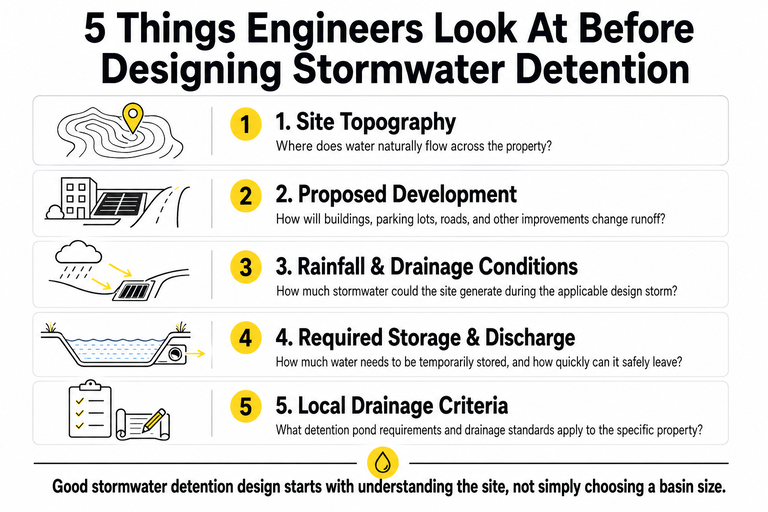
A civil engineer has to look at the existing site, proposed development, drainage patterns, rainfall, soil and topographic conditions, downstream drainage system, and applicable local laws.
This is where storm water detention calculations become important. Here, the engineer generally determines things such as:
- How much runoff the property generates before development
- How much runoff it will generate after development
- The peak discharge rate
- The required storage volume
- How quickly the water can safely leave the basin
- The size and configuration of the outlet structure
- Whether emergency overflow provisions are needed
Here, the exact criteria will depend on the jurisdiction and project. That’s because Texas does not have one single statewide detention requirement that applies identically to every development. Cities, counties, flood control districts, and other local authorities have their own drainage criteria and detention requirements.
What types of stormwater detention systems are used in Texas?
A detention system need not always be a large open pond. Depending on the site development plan and available space, engineers use different detention designs. This includes:
- Surface detention basins: These are the large open grassy areas or ponds you commonly see in subdivisions and commercial developments.
- Stormwater detention ponds: These are designed specifically to temporarily store runoff and release it through a controlled outlet.
- Underground detention systems: These use large pipes, chambers, vaults, or other underground structures to provide storage below parking lots, roads, or developed areas. This can be especially useful when land is limited.
Note: I suggest you don’t stick to a certain kind of detention system just to save the cost of civil engineering. If the detention doesn’t fit your property or development, it won’t hold stormwater as efficiently. Worse, it can create unwanted penalties or liabilities for you.
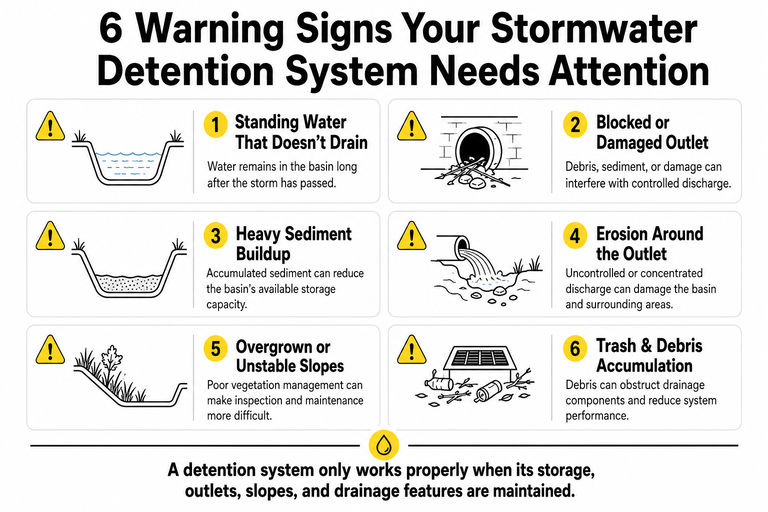
Bonus: Things to consider when planning storm water detention
| Thing to consider | Why It Matters |
| Review local drainage requirements | Requirements vary by jurisdiction |
| Understand existing drainage | Shows where stormwater currently goes |
| Calculate proposed runoff | Helps determine storage needs |
| Reserve detention space early | Prevents site-plan conflicts |
| Design the outlet carefully | Controls how quickly water leaves |
| Plan for maintenance | Keeps the system working as intended |
Conclusion
I am sure that you have a good understanding of what stormwater detention is and why it is so important in Texas.
As you can see, storm water detention is not simply a pond on a property. It is a well planned facility that slows down the increased stormwater runoff created by development and controls how quickly that water reaches the downstream drainage system.
A properly designed storm water detention reduces flood impacts and protects your as well as surrounding properties.
Got more questions about storm water detention or want to design one for your property in Houston?
You can get in touch with us!
At Bullseye Engineering Inspection, our civil engineering services are backed by decades of local expertise and experience.
We help developers, contractors, investors, and property owners make informed engineering decisions throughout every stage of their projects.
FAQs about stormwater detention
What is stormwater detention?
Storm water detention is the temporary storage of excess stormwater runoff so it can be released at a controlled rate. It reduces peak runoff and limits the impact of development on downstream drainage systems.
What is a stormwater detention basin?
A storm water detention basin is an engineered area that temporarily stores excess runoff during rainfall events. It includes an inlet, storage area, and controlled outlet that slowly releases the water.
What is the difference between storm water detention and retention?
Storm water detention temporarily stores runoff and releases it over time, while retention generally refers to keeping a permanent pool of water. The exact terminology and requirements can vary by project and jurisdiction.
Are detention ponds required for all Texas developments?
No. Detention pond requirements vary depending on the location, type of development, drainage conditions, and requirements of the applicable local authority.
Some Texas jurisdictions require detention when development increases runoff or under other specified conditions.
What are storm water detention calculations?
Storm water detention calculations are engineering calculations used to determine runoff, peak discharge, required storage volume, and the appropriate outlet configuration for a detention system.
Can storm water detention be underground?
Yes. Underground detention systems provide temporary stormwater storage where an open detention basin is impractical because of limited site space or other development constraints.